Handcrafted Silver Stud Earrings: From Molten Fine Silver to Sculptural Surfaces
In this tutorial, approximately 2 grams of fine silver are melted down and transformed into a series of sculptural stud earrings. The process highlights essential goldsmithing techniques, surface treatments, and form development, making it ideal for jewellers seeking to refine their skills in small-scale silver work.
The fine silver is first fully melted, ensuring a clean, homogeneous material. Once cooled, the metal is forged flat by hand, using controlled hammer blows to achieve an even thickness while preserving the natural character of the silver. Forging not only shapes the metal but also enhances its structure, preparing it for further forming and surface decoration.
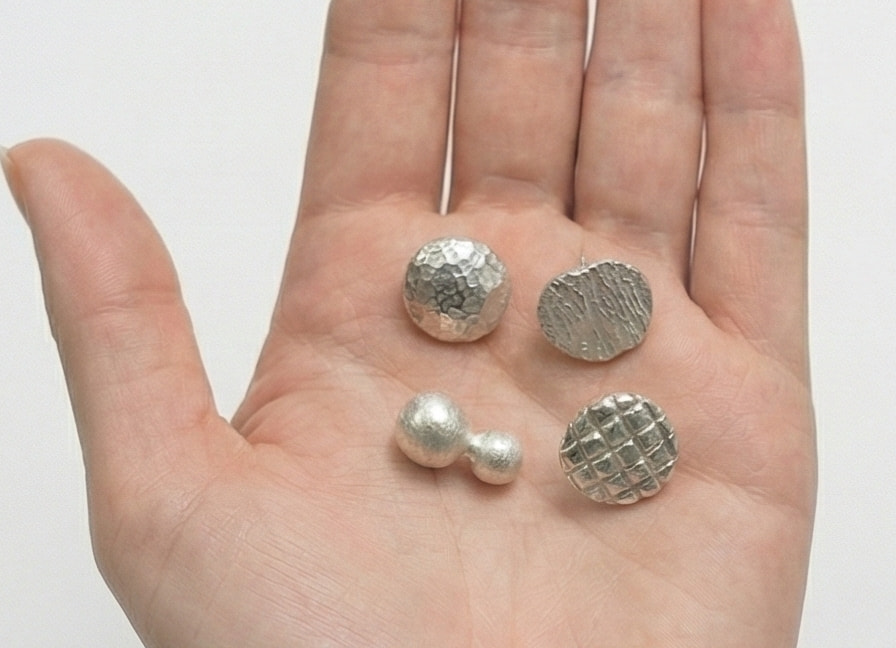
From this single silver blank, five distinct stud earring designs are developed. Each model explores a different approach to form and texture, demonstrating how subtle variations can dramatically change the final appearance. Both concave and convex shapes are created by careful hammering and doming, allowing the silver to catch and reflect light in contrasting ways.
Several designs focus on spherical and semi-spherical forms, achieved through gradual shaping and refinement. These rounded volumes give the earrings a soft, organic presence while maintaining a contemporary aesthetic. Surface decoration plays a key role: textures are applied using controlled hammer marks, matte finishes, and selective polishing to emphasize depth and contrast.
Particular attention is given to edge finishing and rim detailing. Clean, well-defined edges elevate the overall quality of the piece and ensure comfortable wear. Fine silver’s softness allows for precise edge work, whether softly rounded or crisply defined.
Each earring is completed with a sterling silver post, providing strength and durability where it matters most. The contrast between fine silver and sterling silver combines aesthetic purity with practical wearability, a standard approach in professional jewellery making.
Please click on Additional information to find a list of needed tools and further information on this tutorial.